
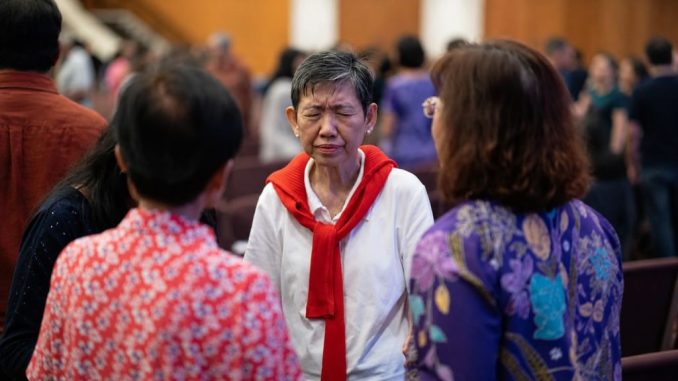
This article was made possible through the support and contributions of Rev Ang and NECF. Christianity Malaysia sincerely thanks them for their hospitality and assistance in providing and reviewing relevant information. We pray that this article will bless the Evangelical Christian community and our fellow brethren in Christ across Malaysia. Photo sourced from NECF’s public social media.
In a country as diverse and complex as Malaysia, Christian unity has often required patience, sensitivity, and quiet perseverance rather than loud public visibility. For more than four decades, the National Evangelical Christian Fellowship (NECF) has served as one of the key bodies representing Evangelical Christians in Malaysia, helping churches navigate questions of faith, public witness, national identity, and cooperation across denominational lines. Though many ordinary Christians may know NECF mainly through prayer initiatives or public statements, its roots lie in a much deeper story about the social challenges faced by the Malaysian church during the 1980s and the desire for Evangelicals to speak and serve together with one voice.
The historical background of NECF is closely tied to a period of growing uncertainty for Christians in Malaysia. During the early 1980s, the nation faced economic difficulty and increasing regulatory challenges. These led to several developments particularly affecting Christian communities. Sensitivities surrounding language use led to restrictions on certain Bahasa Malaysia religious terms in Christian worship and publications, and also affected the use of the Alkitab, limiting it solely among Christians. At the same time, certain regulations also created additional complications for gatherings. Many churches did not own buildings and instead met in rented shop lots or homes, while laws restricting gatherings of five or more persons added another layer of concern for independent congregations.
Against this backdrop, 41 Christian leaders gathered on 21 March 1982 at Luther House in Petaling Jaya. Their purpose was to form a united Evangelical body that could represent Evangelical Christians nationally while encouraging fellowship and cooperation among churches. From this meeting, the National Evangelical Christian Fellowship was born. David Boler became its first chairman, and on 6 May 1983, NECF was formally registered under the Registrar of Societies (ROS).
From the beginning, NECF occupied a unique place within the Malaysian Christian landscape. Malaysia’s Christian community has traditionally been represented through three major umbrella bodies. The Roman Catholic Church represents Catholics, the Council of Churches Malaysia (CCM) represents mainline Protestant churches, and NECF represents Evangelical Christians. Together, these bodies form the Christian Federation of Malaysia (CFM), which serves as a national platform for Christian cooperation and engagement. NECF is also connected globally through the World Evangelical Alliance (WEA).
The Evangelical church landscape in Malaysia is highly diverse. Christians make up roughly 9.2 percent of the Malaysian population. While Catholicism remains the single largest Christian denomination nationally, Evangelical Christianity has a strong foothold in East Malaysia, where the Christian community is highly pluralistic, particularly among indigenous groups in Sabah and the interior regions of Sarawak, and where churches such as Sidang Injil Borneo have become highly influential.
Furthermore, there are more than 4,000 churches nationwide, many of them independent and often charismatic or Pentecostal-leaning, with numerous congregations loosely affiliated with the National Evangelical Christian Fellowship (NECF). Most worship in rented shop lots or temporary premises, and fewer than five percent own their own buildings. The diversity and decentralized nature of the Malaysian Evangelical Church mean that the NECF has never functioned as a centralized authority or regulatory body. Instead, it focuses primarily on fellowship, cooperation, advocacy, and representation.
This spirit is reflected in NECF’s core objectives, which remain rooted in its constitution. The first is spiritual renewal – promoting revival and deeper spiritual life within the church. The second is safeguarding the Christian faith by protecting and spreading Christian belief. Third is encouraging fellowship and cooperation in areas such as evangelism, Bible teaching, welfare work, and social concern. Finally, NECF seeks consultation and unity through working alongside other Christian bodies and engaging respectfully with other religious communities.
In its earlier years, NECF organized national Christian conferences, large evangelistic events, stadium gatherings, and speaking engagements featuring foreign Christian leaders. Over time, however, the Malaysian church landscape evolved. Mega churches began organizing many large-scale initiatives independently, while state-level pastors’ fellowships and interfaith programs also became more common. NECF’s role gradually shifted from event organizer toward coordination, representation, advocacy, and national prayer movements.
One of NECF’s most important contributions has been providing a collective Evangelical voice in Malaysia. As mentioned, Evangelical churches are numerous but often highly independent and decentralized. NECF offers representation to government bodies, provides a platform for dialogue, and encourages cooperation among churches that may otherwise have little direct connection with one another. Its guiding approach is deeply shaped by the biblical principle found in Matthew 5:16: “Let your light shine before men.”
This public witness is not limited to evangelism alone. NECF consistently encourages churches to engage society through disaster relief, feeding programs, orphan ministry, prison ministry, daycare support, interfaith dialogue, and national unity initiatives. Its public advocacy is generally characterized by consensus, humility, and sensitivity. Rather than operating confrontationally, NECF often works alongside CFM and seeks to respect the differing traditions within the wider Christian community.
A significant turning point came in 2001 when NECF adopted a new national vision: “Transforming the Nation Through the Local Church.” The shift reflected an important realization about Malaysia itself. As a multiracial, multireligious, and multicultural nation, Malaysia could not be approached through a single centralized church strategy. Furthermore, the diverse and decentralized structure of the Evangelical church in Malaysia meant that autonomy of individual churches and denominations needed to be respected. Transformation would need to happen locally, through churches impacting their own communities in practical and relational ways.
One of NECF’s flagship national initiatives reflecting this vision is the annual 40-Day Fast & Prayer movement, typically running from August 7 to September 15. The prayer guide is produced in four languages and includes devotional materials for individuals, churches, and the nation. Participation extends beyond Evangelical churches to include Catholics and CCM churches, making it one of the most significant nationwide Christian prayer initiatives in Malaysia.
Underlying this vision is a broader conviction that every Christian is called to be an agent of transformation. NECF teaches that this calling extends into work, family life, community relationships, and society as a whole. It emphasizes that Christians have a purpose within Malaysia itself and that mission fields are not only overseas but also present “in our own backyard,” including among migrant worker communities.
NECF’s ministry areas today include national prayer movements, church planting support, leadership development, discipleship, mentoring programs, and community outreach. Leadership development remains especially important. NECF encourages cooperation with seminaries, supports immigration needs for foreign theological students, and urges larger churches to help train leaders from smaller congregations through in-house mentoring and practical support.
At the same time, NECF continues to face significant challenges. Government policies regarding religion can vary between federal and state levels. East Malaysia and West Malaysia also differ culturally and administratively in important ways. Within Evangelicalism itself, diversity remains both a strength and a challenge. With roughly 1,000 NECF members representing a much wider network of churches, achieving consensus is not always easy.
Yet NECF remains relevant precisely because of its flexible structure and grassroots nature. Many independent churches see NECF as providing a form of “spiritual covering” and practical legitimacy. Membership allows churches to gain legal recognition, open bank accounts, purchase property, and apply for tax exemption. Churches seeking membership must affirm a Statement of Faith, while cults and groups outside orthodox Christian belief are excluded.
Throughout its history, NECF has consistently emphasized that Christian witness in Malaysia must be marked by humility, respect, integrity, and compassion. Evangelism should never involve compulsion or insensitivity. Instead, faith should be demonstrated through good works and service to society. This reflects the biblical images of Christians as “salt of the earth” and “light of the world” found in Matthew 5.
Looking ahead, NECF’s strengths remain its adaptability, relatively low bureaucracy, and strong grassroots connections. Some even believe future church models in Malaysia may increasingly resemble flexible house-church style networks should social conditions become more challenging, complex, or fragmented. Whatever form the future takes, NECF’s enduring conviction remains the same: the church does not exist for self-glory, but to serve others faithfully.
Ultimately, NECF’s story is not simply about an organization. It is about a continuing question posed to Malaysian Christians across generations: Why did God place us in Malaysia? For NECF, the answer has always pointed back toward faithful service, unity amid diversity, and living as a visible witness within the nation God has entrusted to them.
|Share The Good News|



Thank you NECF! In the past 40+ years, you have not only become recognised by the Malaysian government as the representative body for evangelicals but also provided many of the independent churches practical legitimacy and standing – from opening bank accounts to renting places of worship etc. The Lord continue to bless your work as you stand for Him in this nation.