
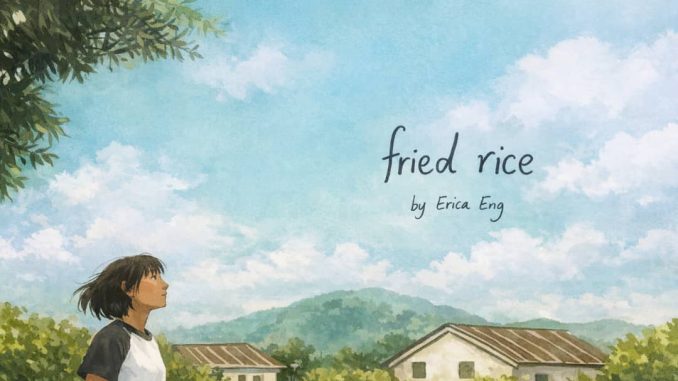
Not every season of life is about reaching some grand accomplishment. Much of it is composed of interludes, those times when ambition slows down and questions of what you’re even doing float silently around. It’s in this essence of life that Erica Eng captures so movingly in her graphic novel Fried Rice. The story is small and ordinary, but full of understated faith. While not overtly a Christian story, Eng dedicates the novel to Jesus and opens with Proverbs 16:3 as an epigraph. That dedication informs the whole work and gives the story its contemplative, meditative quality, pushing it above just another coming-of-age tale.
I didn’t read Fried Rice until quite a while after it was first published in 2024, but I was vaguely aware of the hype it had garnered. Even earlier, Erica had won both the Eisner and Ringo awards for it, way back in 2020, when it had been a webcomic. That was no small feat. Reading it at the end of 2025 meant it stood on its own merit and I could just pay attention to the story.

The title of the book, Fried Rice, strikes one as something fanciful at first, but it works. Erica says it began as a placeholder, named after her favorite comfort food. Simplicity, comfort, warmth – captured through meals, home, memory – become an emotional anchor of sorts for the story.
It’s an easy-going read that gently reflects on the quiet passage of time. Life takes its sweet time moving by on the pages, and any given moment draws to it considerations of waiting, emotion, and that awkward transition in growing up. Min, Erica’s alter ego in the novel, is seventeen and lives in Batu Pahat, Johor. She finds herself in that awkward transition between high school and her next phase of life. Min has her heart set on pursuing an education in animation and making a success of her calling. Her drawings allow her to visit places beyond her own borders, even as she considers fear, hope, and the possibility that maybe she’s not quite ready for things.
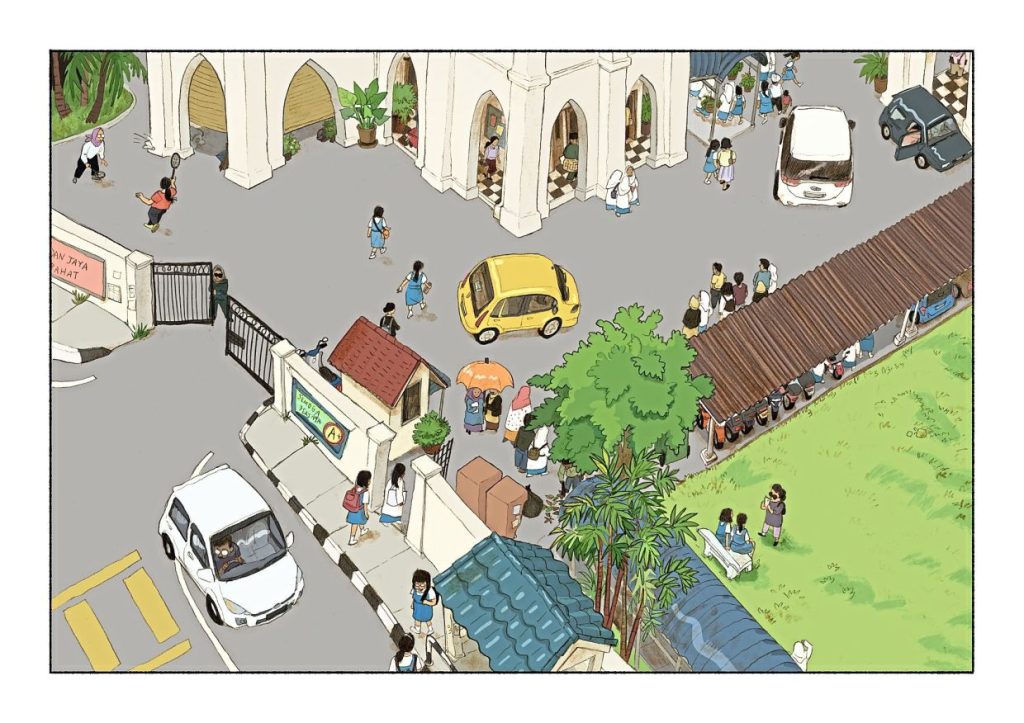
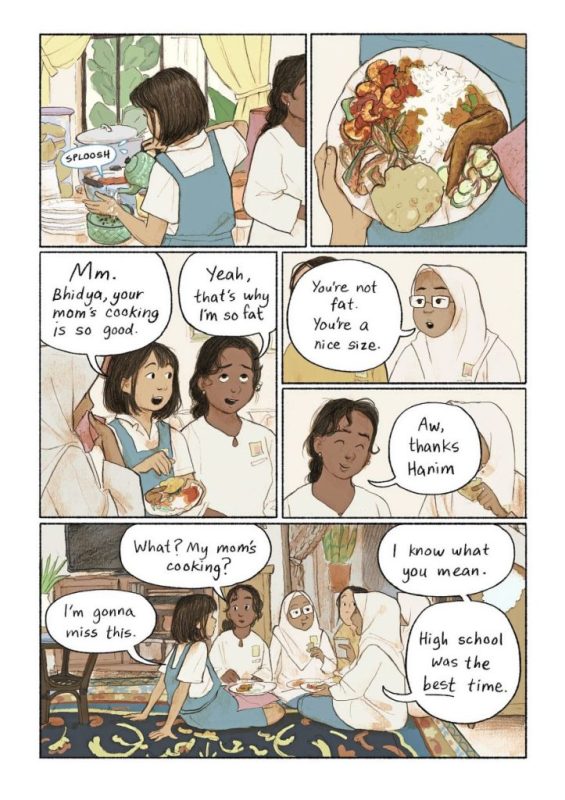
The thing that makes this story linger is how honest it is in its portrayal of the everyday. Min spends Chinese New Year with her relatives in Kuala Lumpur, attends church and youth group, takes care of her pet cat Marko, and hangs out with friends in school, chatting with them in a casual and tender manner. Yet, in these small details of everyday life, a whole universe is awakened. It’s disarming, and yet one starts to find details in one’s own life too such as the scent of kopi, the way sunlight fades into the evening, or a person engrossed in their task.
Disappointment arrives quietly too. Min applies to an art school in New York. She gets rejected. It’s handled sensitively and in a way that’s painfully real. A dull ache and numbness sets in, and there is a wrestling with expectation and self-worth. But there’s also serenity. It doesn’t slip into melodrama, but anyone who has tried hard and fallen short will understand and empathize deeply.
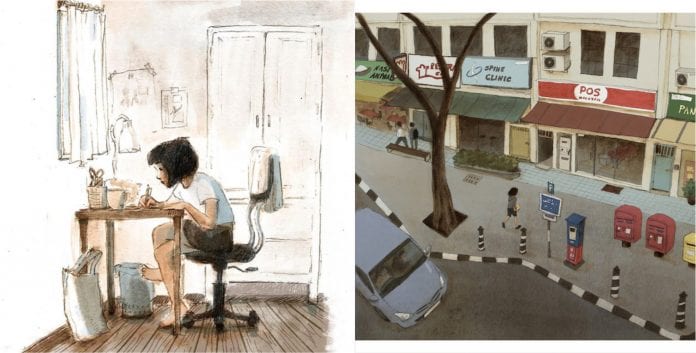
Visually, the book is soft and intimate. The washes look like watercolour, the lines are gentle, sunlight spilling across kopitiams and leafy backstreets, Min drawing quietly, there are many contemplative moments and everything feels alive. Erica trusts that gestures, pauses, and silences can carry the story just as much as plot or action can.
Naturally, not all readers will have the same liking towards the book. Some readers might find it too slow and episodic, and they might be frustrated with the open ending nature of its ending. However, that’s a lot like life, particularly that transitional phase from adolescence into adulthood. Many of us have likely been in that place, and Erica beautifully captures the essence of the experience, letting the reader linger within it rather than trying to ram a moral or a conclusion down the readers’ throat. Despite the book’s tranquil tones, it’s a moving read. The book’s strongest attribute is that it has a clarity about it, at least emotion-wise, that manifests within the reflection of Min’s narrative and the bittersweet aftertaste of the disappointment and the touch of the familiar and belonging.
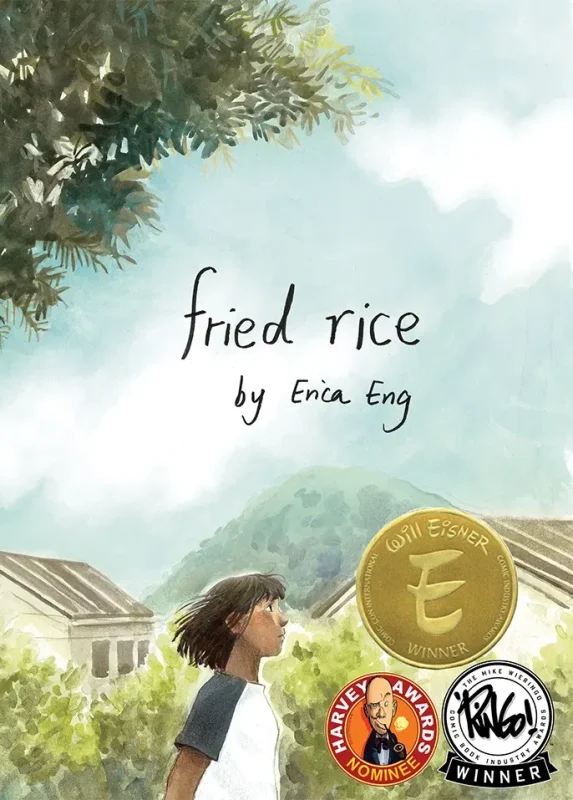
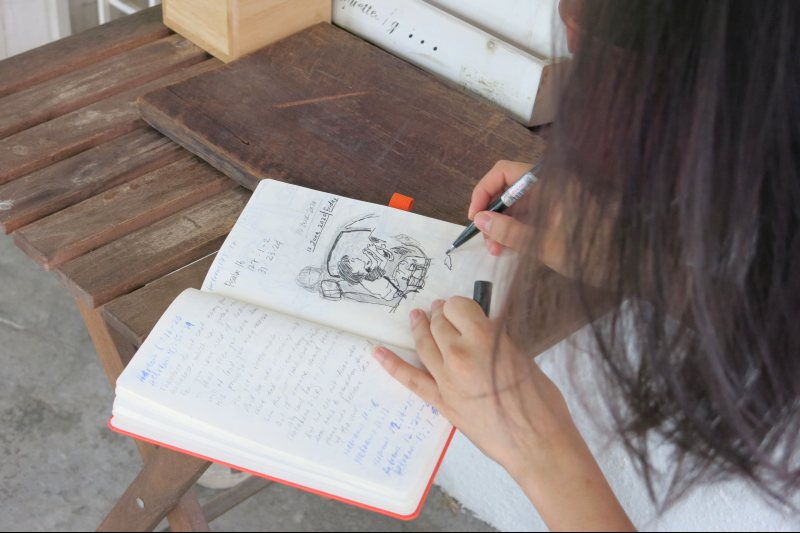
Fried Rice is also important beyond its story. Southeast Asian graphic novels rarely make it to global audiences. Eng’s success – the aforementioned Eisner and Ringo awards, recognition as a Forbes 30 Under 30 – shows that deeply local stories can resonate worldwide without losing their sense of place. This sense of place comes alive in the little details such as local speech, street scenes, and Malaysian food. Min’s world feels lived-in, and the print edition’s afterword, where Erica reflects on her process and inspirations, makes it feel even more intimate, offering a glimpse of her heart in the story, almost like reading along with her diary.
For the Christian reader, there’s another layer. Min reminds us that growth is a slow and gradual process. Rejection doesn’t erase calling. Often, clarity comes not from striving but from paying attention to where we already are. Erica affirms the spiritual weight of stillness, presence, and faithful attention in ordinary life. There’s something nearly sacramental here in the shared meals, familiar streets, and ordinary, unremarkable days – these things shape us.
Fried Rice doesn’t offer tidy answers. It makes space and extends an invitation to notice, to wait, and to reflect. And it’s in that quiet space that it shows us what formation often looks like: God’s work unfolding not in dramatic turning points but in ordinary, patient faithfulness.
|Share The Good News|



Leave a Reply